One platform to run an entire sleep management program, from referral to therapy support.
A single patient's path from referral to therapy crosses referring physicians, sleep labs, home‑testing vendors, scoring teams, interpreting physicians, DME suppliers, and payers — each on separate systems that don't talk to each other. Every handoff loses time, revenue, and patients. And the people running the program feel it daily — chasing, re‑keying, apologizing for delays.
Disconnected systems that only move when a person moves them. Slower, never running overnight, and every handoff is a chance to get it wrong.
Up to five months from referral to therapy, with an exit at every handoff. Insurance, missing data, device training, the referral that never gets made. Across twenty years of operating data, only 50–80% of ordered studies ever complete. Every study that never completes is a patient unserved — and revenue the program already spent to generate.
Reimbursement keeps tightening, and the home sleep testing codes are being rewritten. Growth has to come from doing it for less, not from adding people.
Patients wait months inside a workflow no one designed or supports.
Share of ordered studies that complete the journey today — twenty years of operating data.
American adults have obstructive sleep apnea — and an estimated 80% remain undiagnosed.
Source: AASM, Count on Sleep National Indicator ReportEstimated annual cost of undiagnosed OSA in the United States.
Source: Frost & Sullivan analysis for AASMAmericans suffer from a chronic sleep disorder.
Source: NIH / CDC estimatesEthos Bridge is the neutral, AI‑enabled workflow and data integration layer that turns fragmented sleep signals — rings and wearables, home sleep tests, EMRs, cardiology, DME — into a governed, auditable, physician‑usable record of care. We do not diagnose. We make diagnosis possible at scale.
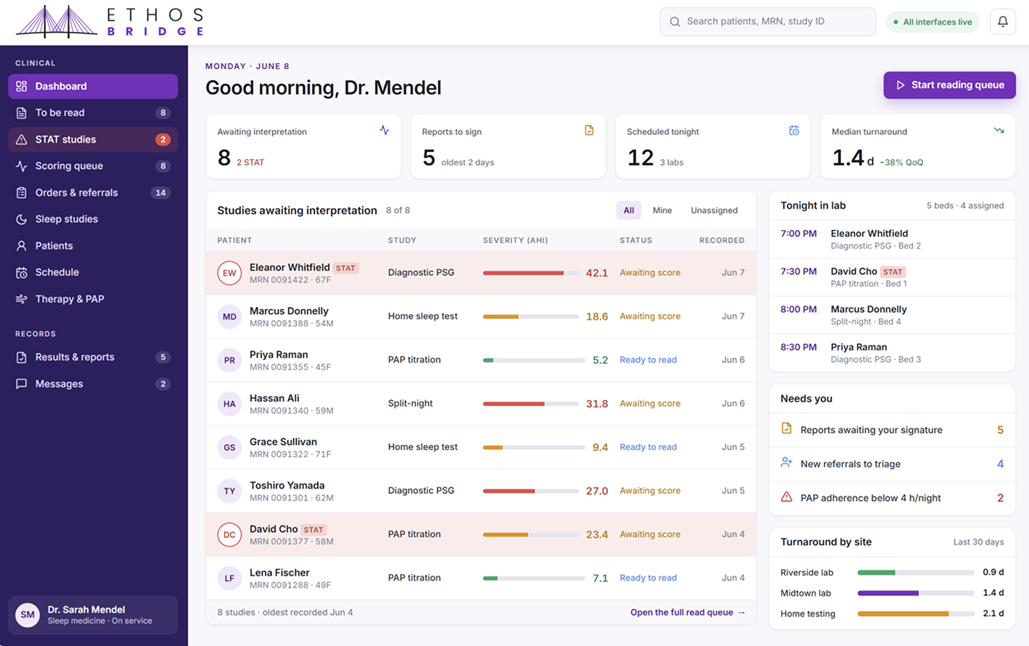
Standardized views let physicians review, interpret, and sign off on studies in one place — including one‑click sign‑off and batch processing — so clinical time goes to clinical decisions.
AI‑enabled workflow automation moves each study from intake to scoring to interpretation to therapy without manual re‑entry. The process is always in motion, so fewer patients fall away between steps.
Non‑proprietary infrastructure: any device maker, lab, or supplier can connect. The platform wins when the ecosystem uses it — not by locking anyone out.
When an OEM or an operating system pushes an update, hospital IT absorbs the breakage — one multi‑site health system in the West saw its workflow break on a single manufacturer's ecosystem. Ethos Bridge owns those connections instead: one vendor to call, everything kept current.
New codes and guideline changes are tracked inside the platform — which stays current so the program's staff never has to.
This is not a prototype. The platform's first modules — intake through insurance authorization, scheduling, and physician interpretation — run in production today inside a national sleep operator.
In production · 2026And it doesn’t stop at diagnosis. DME supply and the treatment pathways that follow run on the same system.
Operators, not tourists.
Built by operators. A team whose programs treat roughly 125,000 patients a year across multiple states — about two million over twenty years — working every OEM and vendor relationship in the category, and carrying the scars.
Leadership that has built three platforms in this industry before this one, now working alongside AI developers and architects to automate the flow they have run by hand for twenty‑five years.
Built on an encrypted, HIPAA-compliant cloud environment · Vendor-agnostic by design
Sleep is no longer a niche. It is now recognized as a contributing factor in heart disease, diabetes, and other lethal conditions — and in daily cognitive performance and alertness. An aging population is living with it in greater numbers.
Awareness has jumped on two fronts at once: GLP‑1 coverage has put sleep apnea in front of millions, and consumer wearables now screen for it at scale, leaving a growing population of patients asking where to go next. What they find is a set of fragmented service lines. Nothing carries them end to end.
The provider pays. Sleep programs license the platform on a subscription plus per‑service fees, out of money fragmentation already costs them — fewer staff hours per patient, fewer patients lost. Downstream, Ethos Bridge earns on placement and services provided to therapy providers.
The program that buys the platform is the program whose staff uses it and the program that captures the return. Pricing detail is covered in conversation.
One connected program: referral to therapy support, on a single AI‑enabled system — the operating system sleep disorder management never had. A program where every referral moves on its own, capture holds above 75 percent, and staff time goes back to medicine. The full argument — the capture‑rate economics, the coming CPT rewrite, and how the category consolidates from here — is shared in conversation.
One step, direct: info@ethosbridge.com reaches the executive team.